

Control by Design: The Economics of Female Powerlessness
Behind the praise for “healthcare heroes” lies a system built to keep women from climbing.

Trump’s first term wasn’t just a policy shift; it marked a structural rollback of women’s rights that often looked less like governance and more like a political clearance sale. Through judicial appointments, his administration enabled the dismantling of federal abortion protections, pushing reproductive rights back into state control. What followed was a fractured system where access to care depended heavily on geography rather than medical necessity, and a constitutional right to bodily autonomy was reduced to a local privilege, something you either had or didn’t, depending on your postcode, like a decent school or clean tap water.
And the architects of this demolition knew exactly what they were dismantling.
They understand that a devastating number of pregnancies begin not in a romantic moment, but at a crime scene, in a haze of intoxication, in a vacuum of power where “no” is not a word but a wall with no echo. They know consent isn’t a notarised contract but a fragile reality, easily shattered by fear, force, or the simple, crushing fact of being a woman in the wrong place at the wrong time. They know this. And they wrote the law anyway.
Let’s skip the hollow courtesy of “not all men.” This is about the ones who hold the gavels, the ones whose signatures become acts of violence dressed in legislative prose.
Once their grip on the physical self is secured, they advance to the next frontier: the systems that sustain that self.
Not just hospital wards.
Not just classrooms.
But the entire, invisible, life-giving infrastructure of care.
Nurses.
Physician assistants.
Social workers.
Teachers.
Professions that generate no shareholder dividends, but only societal function. They don’t make headlines; they make civilisation possible. And that is precisely why they are politically expendable.
These sectors, still locked inside the pink-collar ghetto of “women’s work,” are rewarded with applause instead of economic power. They’re expected to survive on moral virtue while being priced out of the very neighbourhoods they hold together.
The Trump administration did not launch a war. It engineered a famine. It loosened the bolts in the machinery and called it the Golden Age.
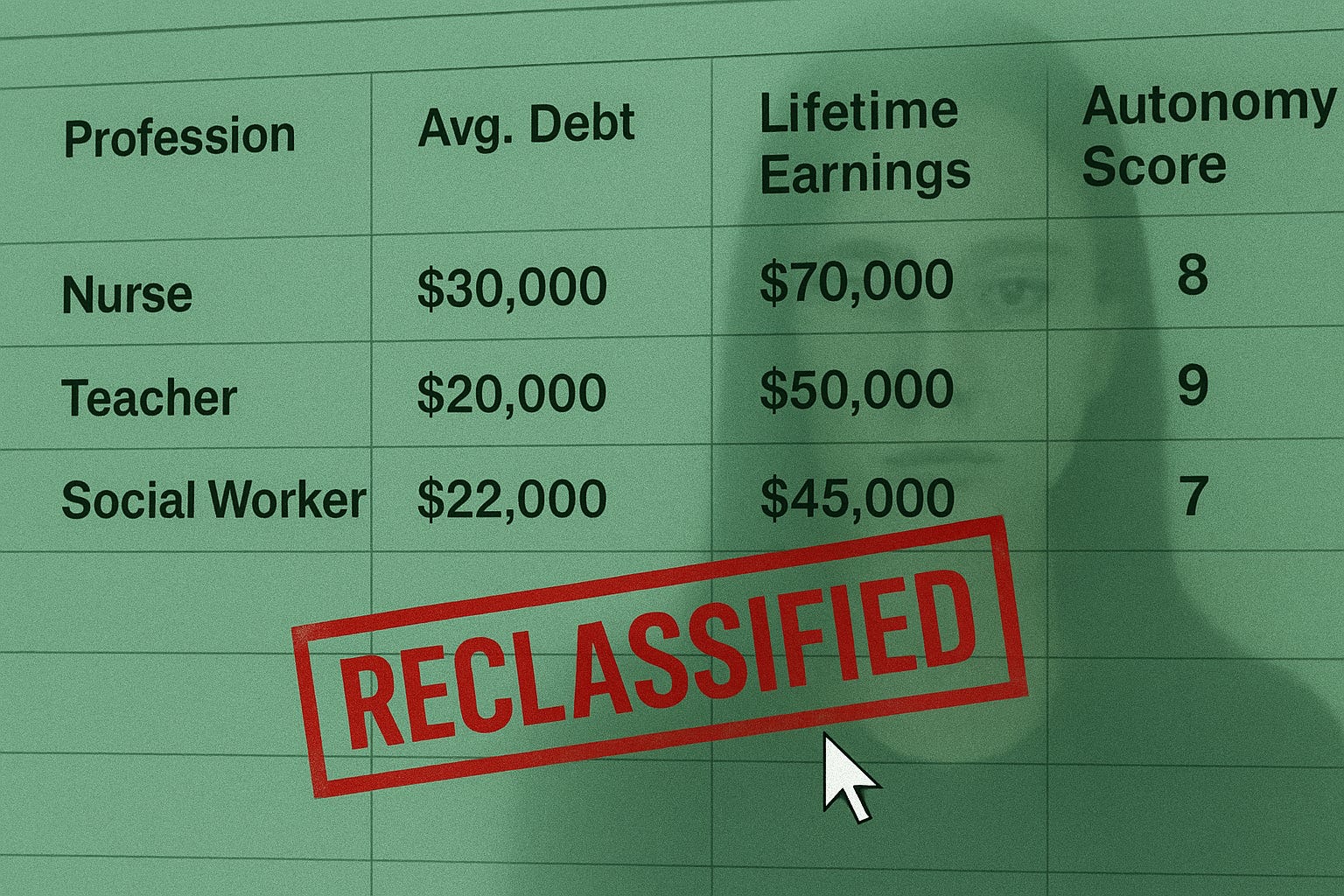
Under Trump’s “One Big Beautiful Bill,” the degrees for these roles were surgically declassified from “professional” to something less.
Not because the science is simplified.
Not because the human body became easier to heal.
But because “reclassification” is a silent, bureaucratic knife, slipped between the ribs of a profession while praising its heroism.
The result is a simple, elegant trap: a $20,500 annual federal loan cap, with a lifetime limit of $100,000.
Tuition stayed bloated.
Workload grew heavier.
Stakes sharpened into debt.
They simply priced out the people.
Not because they couldn’t afford to include them, but because excluding them is cheaper.
A woman in her thirties, trying to climb from aide to nurse practitioner? Her ambition now exceeds her credit.
A single mother retraining as a physical therapist to build a better life? Her choice is now private loan servitude or professional arrest.
A student in a rural town who wants to serve her community? The ladder has been sawed off above the first rung.
The same politicians who performatively genuflect before “our frontline angels” have now calculated the exact financial weight to tie to their ankles.
This is not an attack.
It is containment—engineered, calculated, and designed to last generations.
And because care is the burden society has reflexively handed to women, the fallout is exquisitely targeted—not at the women in corner offices, but at the women holding the entire orchestra of daily life on their backs.
This is not a failure of policy.
It is the policy.
And like all good policies, it was designed to look boring enough that no one panics until the damage is permanent.
First, the body.
Then, the vocation.
A two-act play of power, performed in a language of bland bureaucracy so it never sounds like the scream it is.
And this leads to the question they smother in silence: Cui bono? Who benefits?
There is always a beneficiary.
When public support retreats, private capital advances.
Loan companies.
For-profit education corporations.
Healthcare conglomerates, already sensing the shortage they helped create, are ready to feast on the scarcity.
When access is restricted, education becomes a luxury good. And when that happens, the only students who pass through are those with generational wealth, existing capital, or a terrifying indifference to a lifetime of debt.
This is the intended outcome.
A smaller, more precarious workforce is a cheaper, more pliable one. Less likely to demand. Less likely to unionise. Less likely to walk away from exploitation.
Precarity is their preferred management style.
Hospitals win on payroll.
Lenders win on interest.
Politicians win on a platform of manufactured fiscal prudence.
And women are told their struggle is a failure of personal finance, not a designed outcome of public policy.
This is not an oversight.
It is the cornerstone.
A woman in debt is a compliant employee.
A woman without professional options is a captive audience.
A woman denied advanced education is a testament to “traditional values.”
And all the while, the applause for “healthcare heroes” will thunder from the podiums. The flags will wave. The hollow gratitude will echo, a soundtrack to a quiet, systematic dismantling.
This is not a government that engages in misogynistic shouting matches.
It has outgrown noise. Noise attracts attention. Structure doesn’t.
It has graduated to the silent, efficient violence of the spreadsheet.
It simply redesigns the architecture of opportunity until every corridor leads to a wall, and then sells the enclosure as “security.”
They took choice.
Now they take mobility.
And they’ll call it empowerment, because women are apparently strongest when they have nothing left.
Next comes the cage—economic bars disguised as freedom.
They will brand it reform.
They will market it as freedom.
They will package this regression and sell it as the next great step forward.
And women will continue to be the load-bearing walls of the nation, their hands cracked, their nerves frayed, their potential deliberately stunted—propping up a system that is actively, intelligently, and ruthlessly sawing them off at the knees.
Until we stop calling it complicated and start calling it intentional.
Because systems don’t drift into oppression. They are steered there.
Until we look past the blueprints of policy and see the architecture for what it is:
Not reform.
Not economics.
Not freedom.
Control.