


Every state has moments when it tells itself that ordinary law is no longer enough.
That danger moves faster than courts, faster than oversight, faster than consent.
That safety requires speed, and speed requires authority.
This is how exceptional institutions are born.
Not in calm, but in crisis.
Not with careful boundaries, but with wide mandates and urgent language. Immigration and Customs Enforcement, ICE, was created in exactly such a moment.
Origins: When Fear Becomes Structure
ICE didn’t emerge quietly, and it wasn’t an accident. It was born from pure shock. In the rubble of 9/11, Congress passed the Homeland Security Act of 2002, and President George W. Bush signed it into law. They tore apart the old immigration service and built something new in its place: the Department of Homeland Security. Inside this new fortress, they created three agencies. One to guard the border (CBP). One to process paperwork (USCIS). And one to hunt inside the country: ICE.
This matters. ICE wasn’t a temporary task force or an emergency measure. It was built into the permanent wiring of the American government. Its job wasn’t to help or to process; its job was to find, to arrest, to detain, and to remove. The founding story was national security, but the real product was a standing enforcement force for the American interior.
Panic builds things to last. ICE wasn’t built as a temporary fix; it was built into the bones of the state. Once you have an agency, a budget, and thousands of agents whose job is to find and remove people, that job doesn’t end when the fear does. It just goes looking for new reasons to exist.
Mission on Paper, Mission in Practice
On paper, ICE has a balanced portfolio. It enforces over 400 federal laws. One arm, Homeland Security Investigations (HSI), chases smugglers, traffickers, and cyber-criminals. The other arm, Enforcement and Removal Operations (ERO), is the deportation machine. It runs the raids, manages the detention centres, and loads the planes.
In reality, the weight has slammed down on the deportation side. The data doesn’t lie. By late 2025, roughly 70 to 74 per cent of people in ICE detention had no criminal convictions at all, according to Transactional Records Access Clearinghouse (TRAC) analyses of ICE data. Not a traffic ticket. Nothing. Only about five per cent had violent crime convictions. The typical person in ICE custody isn’t a “bad hombre.” He’s a guy from Mexico or Guatemala who’s been laying roofs or washing dishes in the U.S. for a decade.
This isn’t a police force picking off bad guys. This is a factory. Its product is removals. Its raw material is human bodies in administrative violation. And by 2025, the factory was running at full capacity, shattering records. It’s not about danger anymore, it’s about volume. In 2025 alone, ICE deported approximately 327,000 people, the highest annual total on record, per ICE-tracked figures compiled by The Guardian. Detention capacity reached an all-time high of over 68,000 people held on any given day, as reported in ICE’s biweekly detention releases through December 2025.
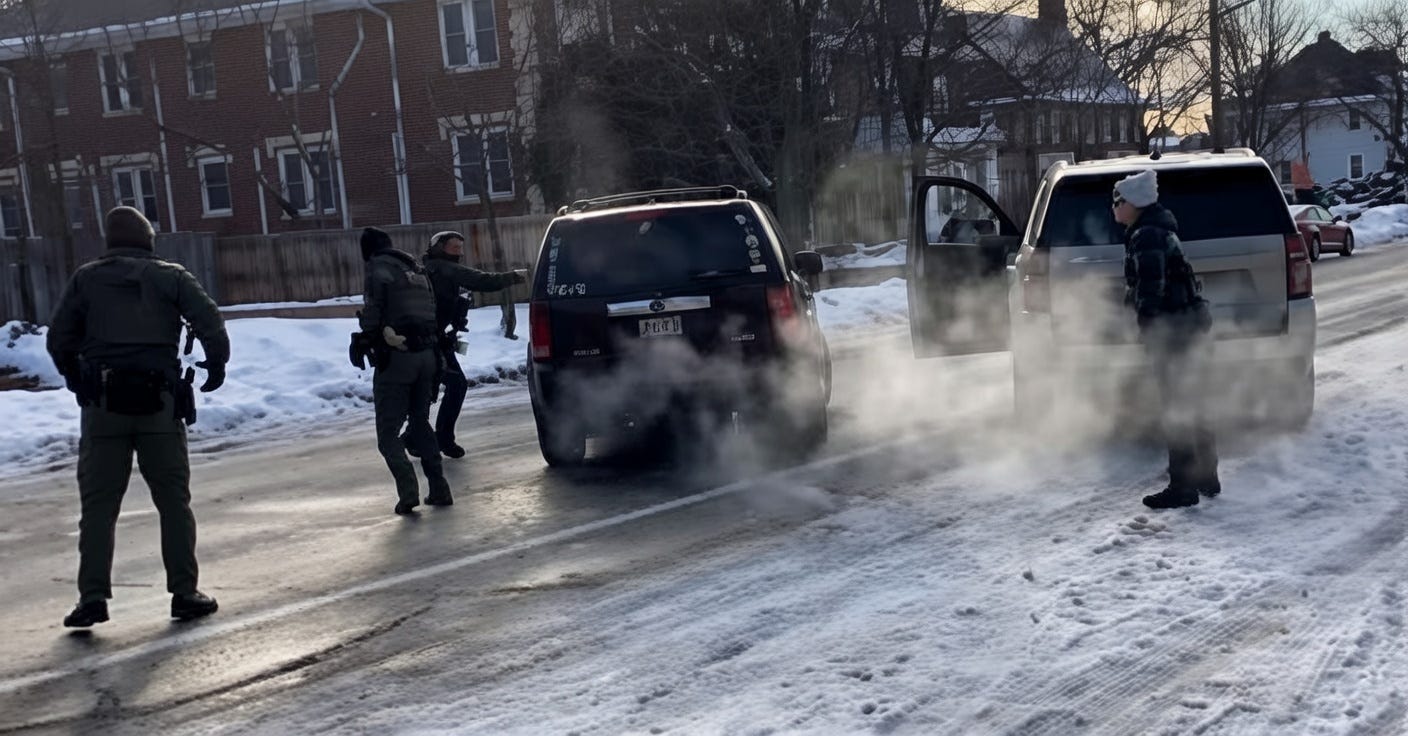
And they carry it out like a paramilitary operation. Masked agents. Unmarked vans. Surprise raids at homes and at work. They often don’t tell local police. Communities don’t get a warning; they get an absence.
You don’t usually see ICE coming. You see them gone. One day, your neighbour, your coworker, the guy who fixes your car, just isn’t there. No explanation, no warning. That quiet, everyday disappearance is their signature. It’s not a bug in the system; it’s the point. The goal isn’t to police a community, but to make it police itself through fear.
Authority Without Proximity
ICE agents carry federal badges. They can operate in any city, in any state, and they don’t need permission. They’re not the military; they don’t have those legal handcuffs. They’re a civilian force with a blank check for the American interior.
Sure, there’s supposed to be oversight. Congress can investigate. Courts can, in theory, intervene. But in practice, it’s a maze designed for delay. In 2025, DHS Secretary Kristi Noem tried to outright ban members of Congress from making surprise visits to ICE detention centres. A judge called it illegal. She issued a nearly identical rule the very next day under a new legal rationale.
When things turn deadly, the walls go up even higher. After a fatal ICE shooting in Minneapolis in January 2026, federal authorities blocked state investigators from accessing the scene, took custody of evidence, and asserted exclusive jurisdiction. Minnesota investigators withdrew, stating they could not conduct an independent investigation without cooperation.
Vice President J.D. Vance went on national television and claimed the ICE agent had “absolute immunity.” That the state could not prosecute him. Constitutional scholars immediately rejected this interpretation, but the institutional message was unmistakable. ICE agents are not formally above the law. They are simply protected by jurisdictional shields that make accountability rare and politically fraught. And when accountability becomes improbable, behaviour adapts accordingly.
Who Bears the Weight
ICE does not publish racial data, but the geography of deportation tells the story. The overwhelming majority of people removed from the United States come from four countries: Mexico, Guatemala, Honduras, and El Salvador. Meanwhile, Black immigrants from Haiti and African nations, though a smaller share of the undocumented population, face deportation at disproportionately higher rates relative to their population size, according to analyses from Pew Research and DHS country-of-origin breakdowns.
Federal courts have already ruled that ICE engages in racial profiling. And in September 2025, a Supreme Court emergency order allowed ICE agents to resume stops based on factors including apparent ethnicity in a Los Angeles profiling case, effectively lowering the threshold for appearance-based encounters. In practice, if you look or sound “foreign,” you are now a potential target in your own country.
And it is mostly men. Roughly 80 to 90 per cent of deportees are adult men, fathers, brothers,and primary wage earners. The damage spreads outward. Families lose income overnight. Employers lose trained workers. Entire streets learn not to answer doors. Trust does not erode gently; it collapses. The real cost is not measured in court filings but in social fragmentation.
When Immigration Enforcement Becomes Political Surveillance
Supporters of ICE’s expanded mandate argue that the agency fills enforcement gaps left by sanctuary jurisdictions, disrupts criminal networks embedded in communities, and protects national security in an era of unprecedented border pressure. Yet this justification collapses under scrutiny. Enforcement data shows that the overwhelming majority of arrests and detentions involve individuals with no criminal convictions, transforming an agency ostensibly focused on danger into one driven by volume and deterrence.
Here is where the mission truly twists. ICE is no longer only tracking immigration violations. It is tracking the people who protest enforcement, who fund resistance networks, and who organise public opposition. DHS officials have stated publicly that protest movements and activist funding are legitimate investigative targets. Internal documents describe left-wing activism as a homeland security threat.
They are no longer only enforcing borders, but policing opposition to enforcement itself. Surveillance tools designed for transnational crime are now used to monitor domestic dissent. Legal aid organisations report clients being questioned or targeted shortly after protests. Opposition becomes risk exposure. Silence becomes self-protection.
At that point, enforcement is no longer just about who crosses a border. It becomes about who challenges the system that polices that border.
Recruitment and Culture: Manufacturing a Mindset
Institutions are built by people. And ICE has been building a very specific workforce. To become a deportation officer, no college degree is required. In August 2025, DHS formally removed both minimum and maximum age limits, allowing applicants aged 18 and up with no upper cap, per Secretary Noem’s public announcement.
Training lasts roughly 13 weeks, shorter than many municipal police academies.
At the same time, recruitment incentives have escalated sharply. ICE now offers signing bonuses of up to $50,000, student loan forgiveness, and overtime systems that can increase salaries by more than 25 per cent. These benefits are marketed aggressively to young applicants facing limited economic prospects.
The messaging is not about legal procedure or civil administration. It is recruitment language borrowed directly from wartime mobilisation. The official website declares: “America has been invaded by criminals and predators. We need YOU to get them out.” Applicants are invited to “choose your mission.”
When officers are taught to see themselves as warriors defending the nation, escalation becomes identity. Every encounter carries symbolic weight. Every civilian becomes a potential threat. This is not accidental. Institutional culture is cultivated.
Minneapolis: When the Blueprint Turns to Blood
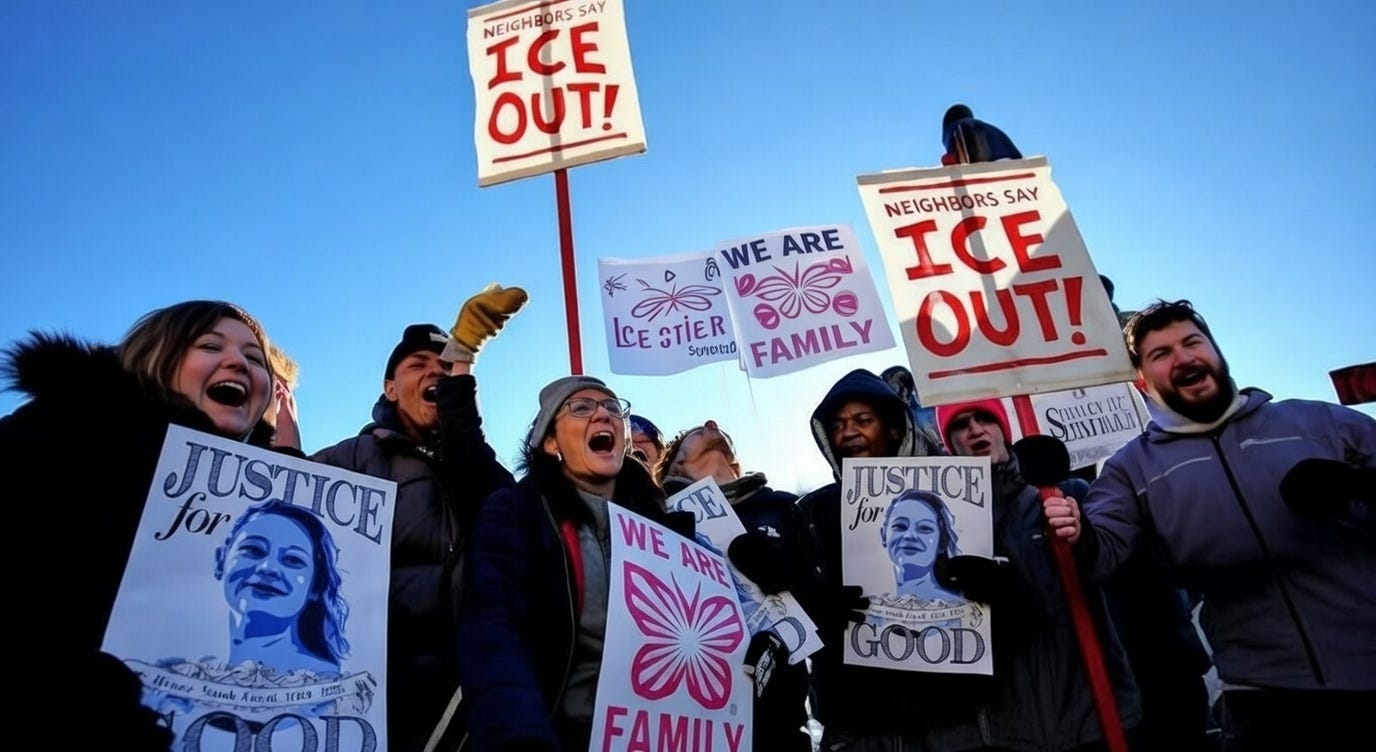
On January 7, 2026, all the theory became horrifyingly real. ICE agents were operating in a Minneapolis neighbourhood. Residents gathered to protest. In the middle of the confrontation was Renée Nicole Good, a 37-year-old U.S. citizen and mother of three, sitting in her car, attempting to leave.
As confirmed by cellphone video reviewed by multiple outlet,s including The Guardian and CNN, an ICE agent, Jonathan M. Ross, stepped in front of her slowly moving vehicle and fired multiple shots through the windshield at point-blank range. Good was killed at the scene.
She was not undocumented. She was not a target. She was not armed.
The institutional response was immediate and unified. DHS Secretary Noem labelled the protest “domestic terrorism” within hours. Vice President Vance declared the agent immune from prosecution and suggested the public should be grateful. The official narrative, that Good attempted to run over the officer, unravelled under video review.
ICE did not suspend operations. It did not invite independent investigation. It closed ranks. The priority was not clarification, but control of the narrative. This was not merely a tragedy. It was a policy moment. And the institution chose insulation over accountability.
Political Reinforcement: The Money and the Message
While public outrage spread, ICE was receiving unprecedented funding. The 2025 immigration package allocated tens of billions of dollars to enforcement operations, detention expansion, and removal logistics. DHS purchased its own fleet of Boeing 737 aircraft dedicated exclusively to deportation flights. ICE now runs multiple removal flights per day to dozens of countries.
Simultaneously, DHS resisted congressional oversight, challenged judicial rulings, and attacked critical reporting. Even during a government shutdown, contracts for executive aircraft were approved. Enforcement was not treated as one policy domain among many. It became political identity, proof of loyalty, spectacle of resolve.
What This Does to a Society
The most enduring impact of ICE is not numerical. It is behavioural.
Workers stop reporting exploitation.
Tenants stop calling housing authorities.
Parents teach children to hide from uniforms.
Witnesses stop contacting the police.
Citizens who look foreign learn that belonging is conditional.
Law ceases to feel protective. It becomes environmental, like bad weather, unpredictable and unavoidable. This is how civic trust collapses, not through decree, but through daily risk calculation.
The Unresolved Question
ICE was created through democratic legislation in response to national trauma. But it has evolved into a domestic enforcement force with expanding authority, limited transparency, and political insulation when harm occurs.
Supporters call this law and order.
Critics call it a shadow force.
Slogans are irrelevant. Outcomes are not.
Who is targeted?
How is force used?
What happens when they get it wrong?
Who answers for it?
So the question is no longer whether ICE enforces the law. It does, relentlessly and efficiently.
The question is whether a democracy can tolerate a federal agency operating this way inside its own communities, insulated from local control, shielded from scrutiny, and politically rewarded for escalation.
And once an institution like this has been built to expand, once it is funded, normalised, and culturally defended, how exactly do you restrain it again?
Or have we already decided that this, the raids, the fear, the immunity, is simply the price of belonging?