


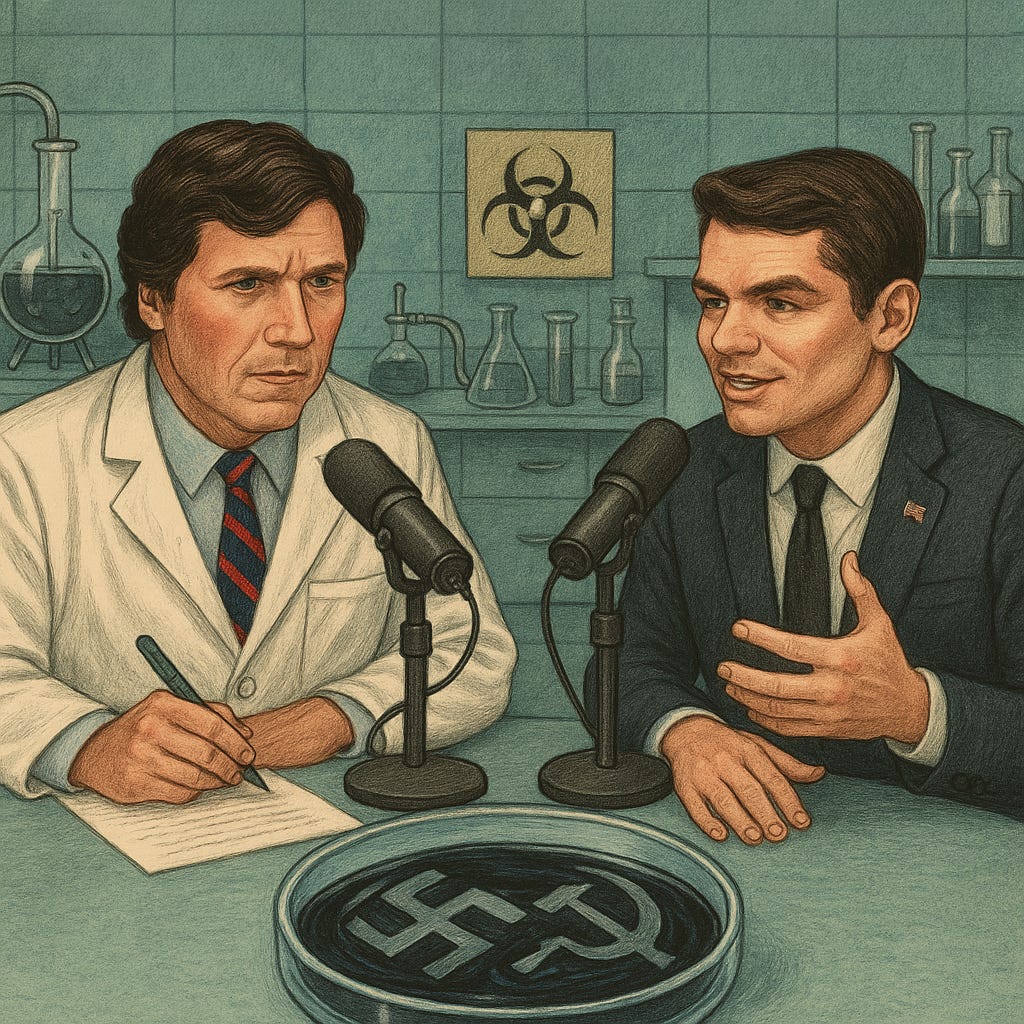
If anyone still clings to the fantasy that journalism is about truth, Tucker Carlson’s interview with Nick Fuentes should put that illusion to rest immediately. It wasn’t journalism. It wasn’t even a debate. It was a laboratory experiment — a clinical, sanitised environment where violent ideologies could be safely handled, stripped of their context, and presented not as threats, but as fascinating specimens. Carlson played the lab-coated technician, observing Fuentes’s pivot from Hitler to Stalin with the mild curiosity of a scientist noting a chemical reaction, never acknowledging the poison in the petri dish.
This, apparently, now counts not as reporting, but as access. Not as an interrogation, but as a platform. Not as journalism, but as laundering. And if that is inquiry, journalism has wandered far beyond the border of relevance.
Fuentes, whose America First broadcasts are essentially cosplay for authoritarian fanboys, pivoted from praising Hitler to praising Stalin. Carlson responded not with a challenge, but with the detached interest of a lab technician observing a specimen. The specimen in question isn’t just a man with extremist opinions — it’s a man who believes women belong in chains, Jews are a problem to be solved, and Hitler had the right idea. No confrontation. Just a belief system, stripped of its violent context, dressed in politeness, and delivered with a signature Tucker chuckle.
Carlson’s drift into this territory didn’t begin with Fuentes. It accelerated after Fox News fired him, a $787 million message delivered via the Dominion lawsuit. He re-emerged under Elon Musk’s wing on X. He promised liberation from corporate interference, but what followed was not liberation so much as entropy. His Moscow supermarket tour, complete with reverent admiration for grocery aisles and shopping carts, felt less like journalism and more like a propaganda-infused spa day for men who think the West is collapsing because their favourite pub added vegetarian dishes. Banality became the selling point: tidy shelves as proof of moral order, fluorescent aisles as evidence of national greatness. Here, authoritarian aesthetics were smuggled in through the harmless language of groceries and cleanliness.
Let’s be clear: Tucker’s Moscow trip wasn’t a new bit. It was a recycled, low-rent act. He is just the latest sucker to fall for a very old trick: mistaking surface order for political health. Guys like him have always done this. They see the empty streets and the glossy grocery stores and think, “So civilised. So controlled.” They never ask what kind of fear produces that level of silence, or what happens to the people who refuse to stay quiet. The dictator changes. The illusion stays.
This same technique of sanitising authoritarianism was on full display in his handling of Fuentes. The self-proclaimed Hitlerfanboy is not a thinker, but a performer of extremism for a bored and disoriented audience. His ideology is less a coherent doctrine than a stitched-together collage of misogyny, antisemitism, and adolescent rage. He doesn’t require intelligence or moral consistency because his followers aren’t seeking philosophy; they’re seeking belonging through shared resentment. In this sense, Fuentes is less a prophet than a podcast bro who discovered that “clickbait for hate” is the one algorithm that never fails. His Stalin praise wasn’t a contradiction; it was improvisation, proof that authoritarian aesthetics matter more than ideological coherence. Carlson’s real failure was not to challenge that, but to treat it as dialogue rather than performance, curiosity rather than strategy, insight rather than propaganda.
The interview was a masterclass in media laundering. Carlson stripped away context, softened tone, and elevated Fuentes under the guise of curiosity. This reframing is devastating because it trains audiences to absorb authoritarian rhetoric as just another viewpoint in the marketplace of ideas. Danger becomes debate. Propaganda becomes conversation. Extremism becomes content.
And this laundering is not accidental. It is a technique refined by media figures who want proximity to extremism without accountability. The formula is simple: strip away history, dilute responsibility, and present radicalism as misunderstood thought instead of hostile ideology. The audience is lulled into reassurance, told that what they are hearing is brave, controversial, or simply “questions.” Carlson’s nodding, his calm tone, his refusal to mention Fuentes’s long record of bigotry — all of it works like bleach on blood, making radicalism appear clean enough to consume.
Fuentes and his ideological circle pinpoint a real feeling—alienation—but misdiagnose the cause. They insist feminism is to blame for the collapse of young men. In reality, the alienation they profit from is manufactured. Feminism didn’t radicalise a generation; grievance capitalism did. Resentment pays — nothing monetises better than fear. The conveyor belt is industrial: loneliness and economic anxiety roll in as raw material, processed through Trump’s architecture, refined by Carlson’s performative outrage, weaponised by Fuentes’s adolescent nihilism, packaged in patriotic branding, and distributed by algorithms that deliver grievance directly to the user.
This conveyor belt is no accident. It is engineered. It’s the architecture of grievance politics, built on white-Christian resentment, fantasies of national decline, and obsessions with “traditional values” that conveniently exclude modern reality. Trump laid the scaffolding. Carlson refined it. Fuentes weaponised it. Together, they form a pipeline of disaffection and dominance politics, presented as patriotism but functioning as an emotional shelter for men terrified of irrelevance.
And here lies the final absurdity: Fuentes’s followers are told feminism is the cause of their suffering, while the men feeding them that lie are the ones cashing in on it. The malaise is not accidental; it’s curated. Feminism is just the cheapest scapegoat in the authoritarian playbook: blame the powerless, distract from the powerful, and keep the machine running.
To call Carlson’s interview with Fuentes journalism would be generous to the point of delusion. It was not reporting. It was not a political interview. It was content engineered to make extremism appear conversational, safe enough to scroll past on a phone between coffee and emails. It wasn’t designed to inform, but to normalise. And that’s the real threat: when figures with enormous reach begin packaging authoritarian worldviews as harmless intellectual exercises, democracy doesn’t collapse loudly. It erodes quietly, through familiarity.
Carlson didn’t accidentally normalise Fuentes. He chose to. He showed how comfortable he is with inhumane politics, how eager he is to amplify even the most toxic voices if they promise engagement, and how far he’s drifted from anything resembling journalistic ethics. Fuentes, for all his extremism, is at least transparent. He tells you exactly who he is. His ideology isn’t hidden; it’s openly broadcast daily.
The real danger lies in the men who hear all that and decide it deserves amplification. Carlson didn’t expose Fuentes. He exposed the ecosystem he belongs to — one willing to trade democracy for clicks.
This wasn’t journalism. It was complicity disguised as curiosity. It was civility weaponised in the service of extremism. It was a theatre masquerading as an inquiry. And if audiences keep mistaking this performance for journalism, the distance between democracy and decay won’t just shrink — it will collapse.