


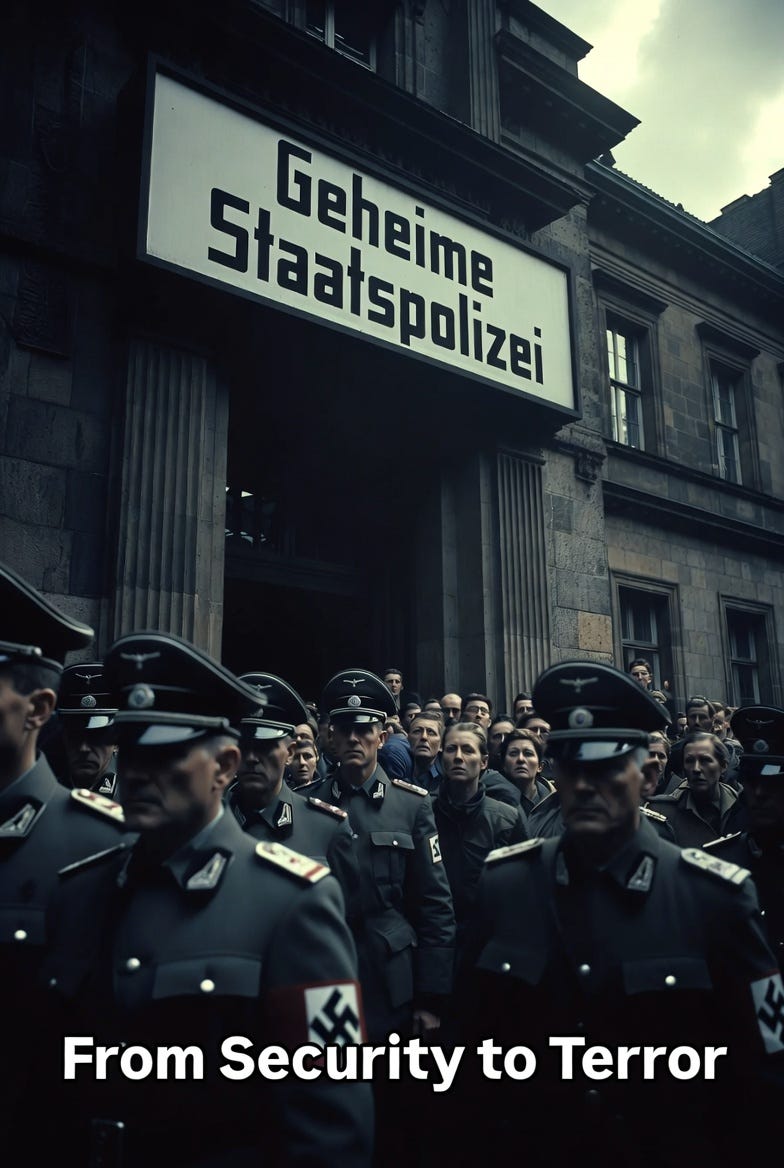
Picture a state that has decided elections are an inconvenience, courts are a nuisance, and rights are negotiable. It does not begin with mass murder. It begins with “security.” It begins with the claim that the nation is under threat from internal enemies, that ordinary law is too slow, too soft, too full of procedural obstacles, and that exceptional measures are now required for exceptional times.
This is the moment when governments create institutions that do not exist to protect citizens from violence, but to protect power from citizens.
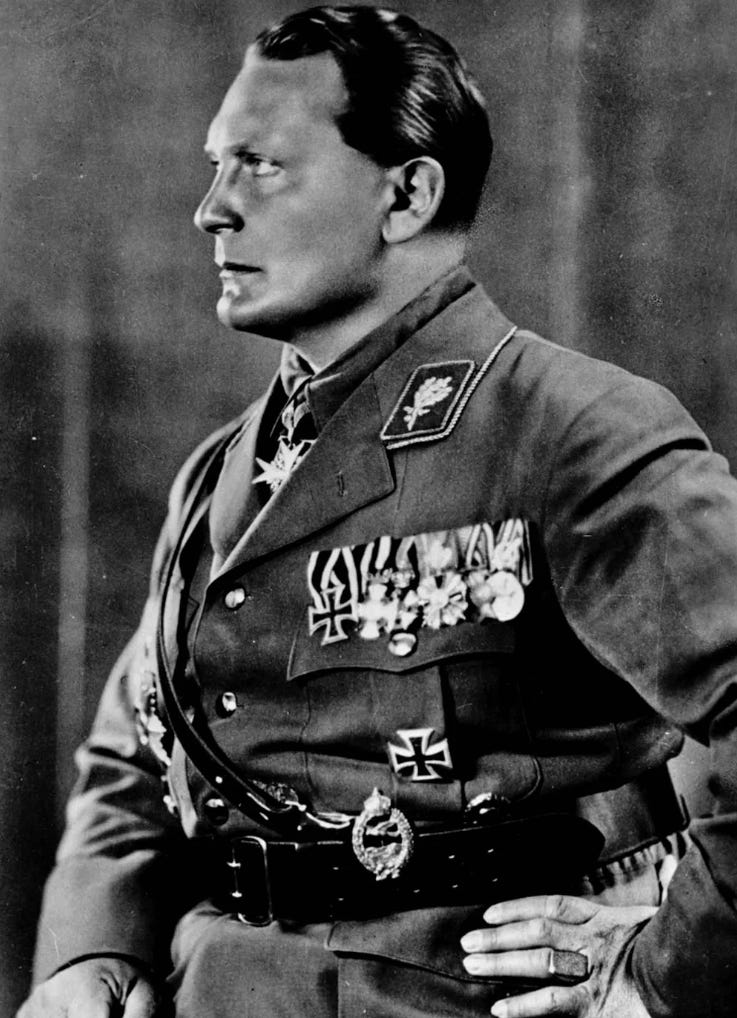
In Nazi Germany, that institution was the Gestapo. The Geheime Staatspolizei, the Secret State Police, was formally announced on 26 April 1933 in Prussia, the nation’s largest and most powerful state. It was not born of legislation or democratic will. It was a creature of decree, created under Hermann Göring—then the Prussian Minister President and Interior Minister—who reshaped and centralised Prussia’s existing political police into a new organisation built explicitly to serve the new regime. This was not a democratic process. There was no transparent debate, no independent oversight, no judicial constraint. It emerged through raw administrative power and executive fiat at the precise moment the Nazi state was dismantling political pluralism and civil liberties. The Gestapo’s origin is inseparable from the broader authoritarian seizure of the state: it was the deliberate weaponisation of government institutions against political opponents. And Göring matters here. He was no minor bureaucrat. He was one of the most powerful men in the Nazi hierarchy, a man who would later be sentenced to death at Nuremberg for his crimes, cheating the hangman only by committing suicide in his cell.
Its creation had a single, brutal purpose: to eliminate opposition and enforce ideological control. Its stated mission was state security. Its practical mission was political domination. In 1933, the Nazis’ priority was to crush organised political resistance inside Germany. The early “enemy list” was not vague. It was concrete and immediate: Communists, Social Democrats, and trade union leaders were the core targets from the very beginning. The Gestapo was never a neutral police body that later drifted into abuse. It was designed as a political instrument from its first breath.
It began in Prussia, but its field of operation grew with the regime’s ambition, expanding as Nazi policing was centralised across all of Germany, and later operating across German-occupied Europe, embedded within the wider SS and security apparatus. But its power did not come from omnipresent surveillance or overwhelming manpower. It came from a far more lethal and sophisticated combination: legal exception, cultivated fear, and the active participation of the society it terrorised.
Its modus operandi was a blueprint for modern terror. It relied on intensive political surveillance, targeting individuals for their affiliations, private speech, associations, and mere perceived disloyalty. Crucially, a significant share of its investigations sprang from denunciations—reports volunteered by the population. The research of historians like Robert Gellately highlights how Nazi terror often depended not on secret agents, but on information freely given by ordinary citizens. This is the first masterstroke: it shows how a society can be pulled into policing itself. The legal mechanism for this terror was “protective custody” or Schutzhaft—the authority to detain people indefinitely without specific charge or trial. Under the Nazis, this became a routine administrative tool to remove political opponents and other targeted groups from public life, a bureaucratic signature that fed people directly into prisons and concentration camps. This system operated in a void. As the US Holocaust Memorial Museum documents, the Gestapo was not subject to legal or administrative oversight; courts could not overrule its decisions. Its repression was administrative terror. Arrests became files, transfers, orders, and quiet disappearances. This is how terror scales efficiently.
And who were its targets? They were never abstract. They were politically and ideologically defined, with the categories expanding relentlessly as Nazi policy radicalised. In the first phase, the Gestapo prioritised political opposition: Communists, Social Democrats, trade unionists, and wider circles of anti-Nazi activists, journalists, and critics. The US Holocaust Memorial Museum emphasises that in these first two years, the Gestapo’s focus was squarely on political opponents. When Jews were arrested early on, it was often because they were framed as Communists or Social Democrats first. But as Nazi policies evolved toward systematic persecution and genocide, the Gestapo became a key actor in the machinery of the Holocaust, enforcing anti-Jewish measures and later orchestrating the roundups and deportations to the camps. Authoritative summaries consistently describe its pursuit of a broad range of other “enemies”: intellectuals, political clergy, homosexual men, and any group labelled “undesirable” by the regime. A necessary correction, for accuracy: “feminists” were not a formal bureaucratic category like the others. Women were targeted when they belonged to political movements, labour networks, or resistance activities. Repression followed affiliation and action, later expanding into the racial and social categories of Nazi ideology. The point is not that everyone was equally likely to be arrested. The point is that the regime reserved the unlimited right to decide who counted as dangerous, and the Gestapo possessed the unchallengeable power to make that definition a material reality.
The impact of this was not merely a body count. The Gestapo’s most enduring achievement was the way it reshaped the very fabric of everyday life and social behaviour. Fear became normal. When people can be arrested without trial, fear detaches from individual cases and seeps into daily calculations: what to say, whom to trust, what to avoid, what not to be seen reading, who not to be seen with. The Gestapo trained citizens to internalise risk. Consequently, trust collapsed because society had been turned into a reporting network. If denunciations are routine, you begin to live in a social minefield. Personal grudges become political accusations; ordinary conflicts gain lethal consequences. Gellately’s work is crucial here, highlighting that a dictatorship does not need total surveillance if parts of society begin to police themselves.
Simultaneously, the rule of law was hollowed out. When an institution like the Gestapo is insulated from all legal oversight, law becomes a performance, a pantomime of justice. The Holocaust Memorial Museum’s note that the Gestapo had the final word, that courts were powerless, is not a technical detail. It is the psychological pivot from citizen to subject. This persecution was procedural and therefore horrifyingly scalable. The violence was not only physical; it was administrative. Arrests, protective custody orders, transfers—all documented, all unchallengeable, as detailed in the Yale Avalon Project’s Nuremberg documentation. This revealed the final, chilling lesson: a society can be controlled without constant visible brutality. A secret police does not have to stand on every corner if it can create the belief that it might, and if the penalties for being targeted are severe, unpredictable, and absolute. That is how terror becomes culture.
The essential conclusion is this: The Gestapo was not simply a group of violent men. It was an institution meticulously built to detach policing from accountability, to detach punishment from law, and to detach fear from any rational boundary. Its deepest impact was not only on those it arrested. It was on everyone else who learned to adapt, to self-censor, and to survive by narrowing their life, thought by thought, until it fit silently inside the space the regime allowed. That is the true, enduring work of a secret police: not only removing enemies, but manufacturing obedience.