


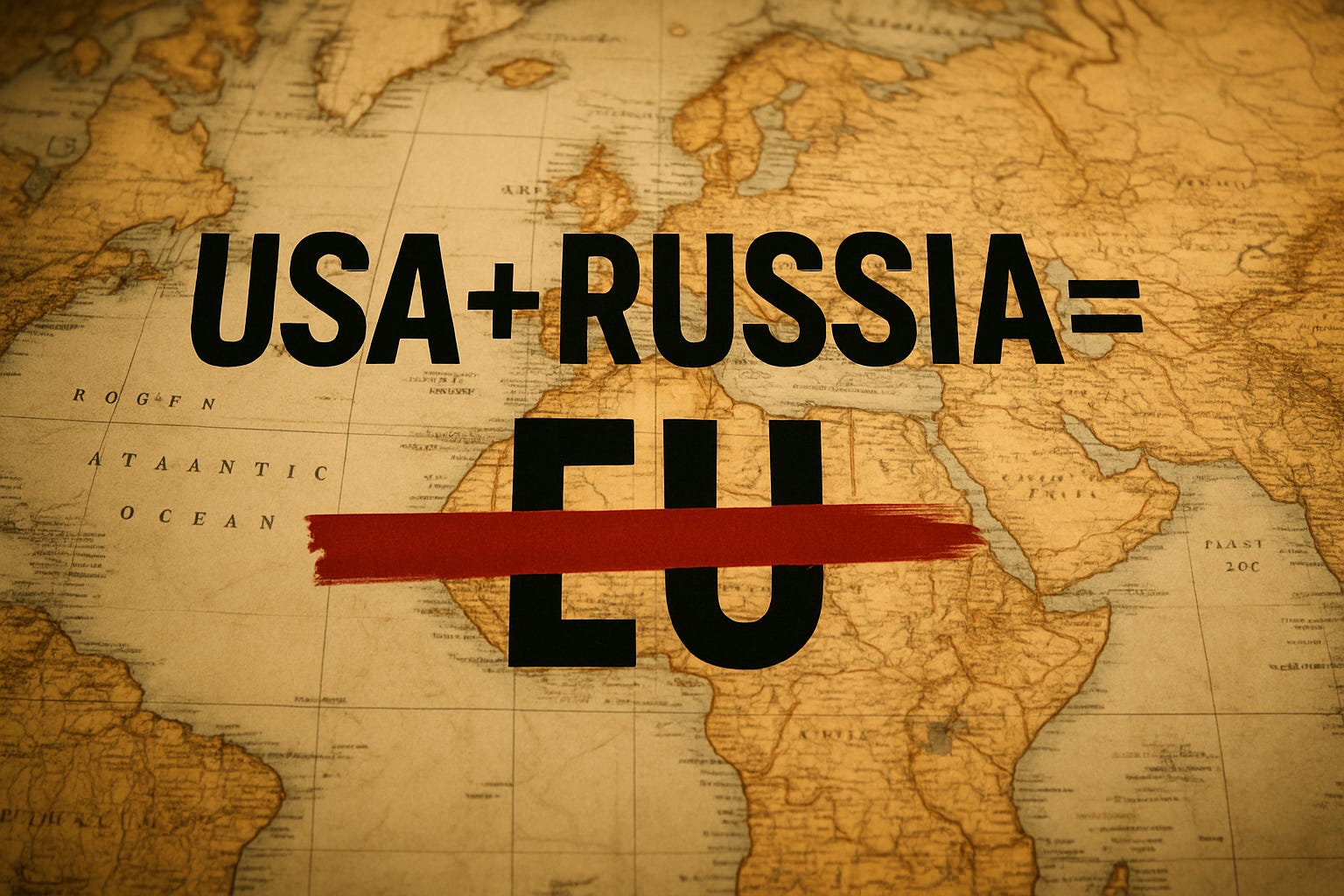
There is a 33-page document on the White House website right now that should worry every democracy in Europe. It’s called the National Security Strategy of the United States, and it reads less like a foreign-policy blueprint and more like a culture-war sermon. The references to democracy have nearly disappeared; alliances are demoted; Europe is reframed as a civilisation losing its grip. And somewhere in Moscow, the applause was immediate.
This should not be treated as a footnote. It should be treated as a geopolitical siren.
The NSS is supposed to be the clearest expression of America’s national priorities. For decades, that meant defending democracy, shoring up NATO, and keeping Russia’s ambitions in check. But this version does something else entirely: it echoes European far-right narratives, criticises EU governments using Fox-style talking points, and positions the United States as a kind of civilisational auditor sent to correct Europe’s moral decline.
The document is short on democracy and long on grievance.
You can read it here
“Democracy doesn’t disappear all at once. First, it vanishes from speeches. Then from the strategy. Then from the culture.”
The language alone is a warning. Biden’s 2022 strategy mentioned “democracy” more than ninety times. Obama’s 2015 version used it seventy-six times. Trump’s first NSS still managed around thirty. This one? Five. Five small, lonely appearances in a document that claims to articulate America’s role in the world.
And the context is not the traditional celebration of democratic alliances. Instead, the strategy accuses European governments of “trampling” core freedoms, suppressing opposition, censoring speech, and losing their “self-confidence” and “Western identity.”
The shift is unmistakable: Europe is no longer an ally to be supported. It is a civilisation to be corrected. And suddenly, the historian in you starts whispering words like “Weimar.”
What makes this even more surreal is the White House’s renewed devotion to the Monroe Doctrine. The NSS announces a “Trump Corollary” that declares the Western Hemisphere America’s primary sphere of influence. Europe, by implication, is something like a distant cousin — important on holidays, irrelevant the rest of the year.
Russia’s reaction to the new strategy was instant and telling. Kremlin officials praised that the document broadly aligns with Russia’s vision — a sentence no European leader ever wants to hear associated with American policy.
They liked the criticism of Europe. They liked the civilisational framing. They liked the demotion of democracy. And they especially liked the softening around Ukraine and NATO’s future burdens. The Kremlin recognised a familiar script: a divided Europe, a self-absorbed America, and a geopolitical landscape where spheres of influence replace shared values.
What Europe heard as an insult, Russia heard as encouragement.
“Putin doesn’t need America to support him. He only needs America to stop supporting Europe.”
Meanwhile, MAGA world understood the document exactly as intended: as validation. For years, figures like Nigel Farage, Marine Le Pen, and Viktor Orbán treated Trumpism as an ideological older brother — brash, chaotic, but influential. Now, that bond has its first official policy paper.
Germany’s AfD, already surging toward unprecedented national support, has openly cultivated ties with Trump allies and celebrated the new NSS as proof that their narratives about migration, identity, and “EU overreach” are gaining global traction.
France’s National Rally echoes almost line-for-line the same vocabulary about sovereignty and civilisation. Austria’s FPÖ markets its anti-EU hostility as alignment with a new American era. And Italy’s government — hard-right and rhetorically fierce — finds itself conveniently absolved of its migration failures by a U.S. document that treats Europe’s borders as a moral referendum rather than a logistical one.
This is not transatlantic cooperation. It is transatlantic radicalisation.
And we’ve already seen the prototype: Brexit.
We now know how deeply American and Russian influence networks were involved in the 2016 referendum — from Cambridge Analytica to dark-money channels to coordinated messaging campaigns.
(Guardian: https://www.theguardian.com/politics/2020/jan/15/brexit-disinformation-campaigns)
Brexit wasn’t just a British earthquake. It was a proof of concept for how to fracture the European project. The 2025 NSS reads like the spiritual sequel.
The European Council’s reaction captured the geopolitical danger: EU leaders accused Washington of interfering directly in internal European politics by endorsing narratives used exclusively by Europe’s far right.
At a moment when Russia is still waging war in Ukraine, when misinformation floods the continent, and when extremist parties are not just rising but winning, the United States has decided to step away from its role as stabiliser and step into the role of culture-war exporter.
“The United States hasn’t withdrawn from Europe. It has chosen a side in Europe’s internal struggle — and it’s the side cheering for the dismantling of the EU.”
The result is a Europe exposed in ways it has not been since the 1930s.
Germany’s AfD climbs. France teeters. Austria leans hard right. Hungary and Slovakia drift closer to Moscow. Italy embraces illiberal rhetoric while its migration numbers hit historic highs. European democracies are not falling, but they are wobbling. And this time, there is no steady partner across the Atlantic offering reinforcement.
The new doctrine from Washington tells Europe, plainly:
Your democracy is your problem now.
Your unity is optional.
Your far right is legitimate.
Your institutions are negotiable.
Your civilisation needs repair.
It is not simply an abandonment. It is an invitation to fracture.
And the applause from Moscow confirms exactly who benefits.
The strategic reality is now unavoidable: Europe must defend its democratic order largely alone. The United States has stepped back into a 19th-century worldview, Russia is seizing the narrative terrain, and Europe’s far right is rising into the vacuum.
If Europe treats this moment as anything less than a structural break, it will repeat the oldest mistake democracies make: believing that decline only happens elsewhere.
“When America stops seeing democracy as its mission, someone else writes the story of the West. And right now, the authors waiting in the wings do not believe Europe deserves a happy ending.”