


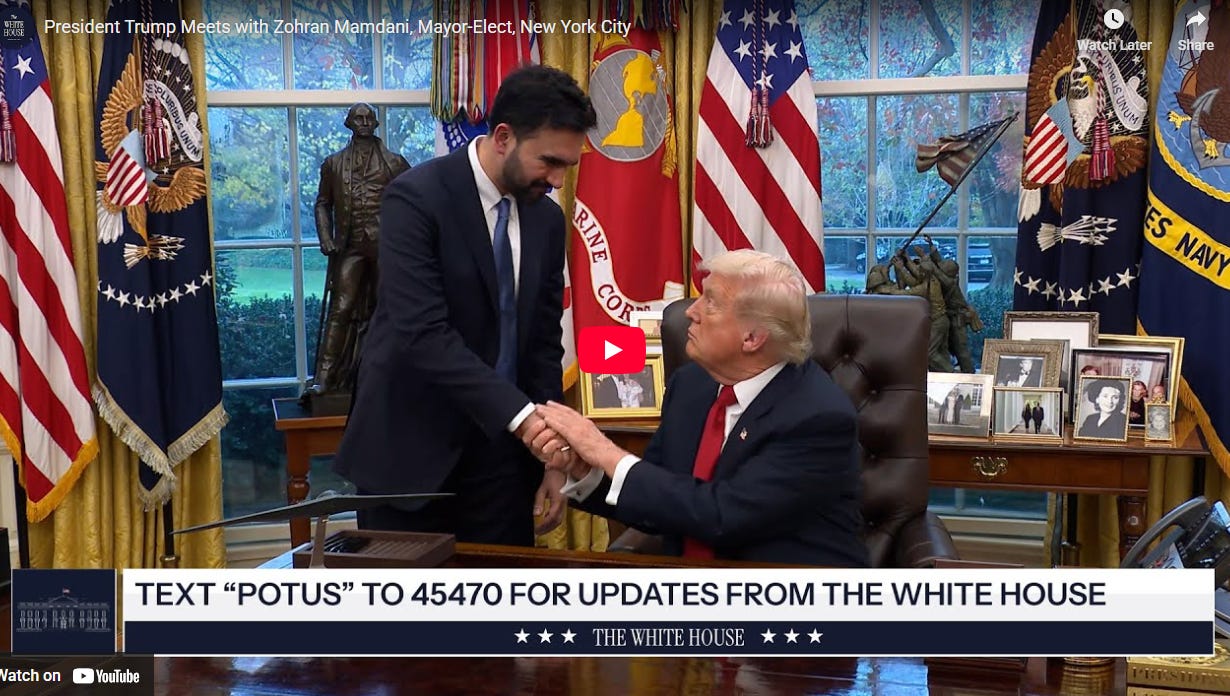
Meetings in Trump’s Oval Office are less meetings and more survival trips. The room stays the same, but the genre changes every time — humiliation comedy, loyalty test, psychological experiment. A place built for history now functions like a reality-TV confession booth with better curtains and décor so loud it challenges the Constitution.
And we’ve seen the Oval Office do its worst.
We watched a wartime president walk in from an actual battlefield and get treated like a poorly prepared intern. Volodymyr Zelensky, fighting off Russia with dwindling ammunition and borrowed time, arrived wearing a military-style black sweatshirt and the weight of his entire nation. Trump mocked him for it. For the clothes. For the missing note cards. For failing to perform “respect to a man who has never shown respect for anyone.
That is the tone-setter. That is Trump 2.0’s Oval Office: foreign policy downgraded to outfit commentary.
So when Zohran Mamdani stepped inside, the expectations were already loaded.
This wasn’t a meeting. It was a pre-scripted boxing match.
Social media had the hype posters ready:
Trump vs. The Socialist Kid From Queens.
The strongman vs. the democratic socialist.
Capitalism vs. whatever Fox News thinks “communism” is this week.
If you placed bets on X, Trump was the favourite by knockout.
Thirty seconds. Tops.
The president had spent weeks calling Mamdani a “communist lunatic”, the GOP had painted him as the new face of Democratic extremism, and Laura Loomer was busy testing new slurs in the political focus groups of her dreams. By all logic, Mamdani should have been fed to the same Oval Office machinery that ate lesser men in suits.
But the script cracked.
And that crack is where the real story begins.
From “Communist Lunatic” to “I’ll Be Cheering for Him”
Before Mamdani ever entered the room, Republicans had already airbrushed him into the perfect villain. He hit every trigger word they adore: young, attractive, smart, wealthy, well-educated, cultured, muslim, woke, leftist, urban, reform-minded, and optimistic about things other than tax cuts.
He was supposed to be their 2026 poster child for what happens when Democrats “go too far”.
Every suburban mailbox was one Photoshop session away from receiving a flyer warning that “Mamdani-style socialism” would tank property values, raise crime, and cause generalised collapse in the most important city of America and its entire masculinity.
Then the cameras rolled.
Trump, seated behind the Resolute Desk, did not attack. He smiled. Leaned back. Relaxed. Reached out to tap Mamdani on the arm, as if he were welcoming a promising apprentice. The man who had rant-screamed about Marxist gulags suddenly declared, live on camera, “I’ll be cheering for him.”
You could practically hear Republican strategists burning their campaign plans in real time.
And Mamdani?
He stood there with the composure of someone who has read the chapter on narcissism in politics twice and highlighted the good parts.
Hands clasped. Posture calm. Expression polite, not deferential.
He didn’t storm the citadel. He didn’t grandstand.
He simply did not give Trump the emotional energy he feeds on.
It was a masterclass in not poking the beast.
This wasn’t appeasement.
This was handling.
The Psychology of Meeting the Narcissist Without Becoming His Entertainment
You do not walk into the Oval Office and try to out-volume Trump.
You do not escalate, because escalation is his oxygen.
You make the room boring. You make the fight unwinnable. You pivot.
And pivot Mamdani did. Every time.
Asked about “jihadists”? He pivoted to affordability.
Asked about fascism? Affordability.
Why meet with Trump at all? Affordability.
Concerns from residents? Affordability.
Middle East differences?
You guessed it: affordability.
Housing. Rent. Groceries. Utilities.
The daily violence of expensive living.
Trump, hearing this, did what he always does when confronted with an unexpected calm: he recalibrated. Narcissists love novelty. Mamdani wasn’t another Democrat performing outrage. He wasn’t a foil. He wasn’t an enemy with a script. He was… grounded. And extremely popular!
Trump switched roles instantly.
From combatant to benevolent patriarch.
From threat machine to supportive dad at a middle-school recital.
It cost him nothing. It made him look generous.
It made him feel adored, the only metric he respects.
And suddenly, the political villain Republicans had built could not be villainised in that moment, because Trump himself refused to play along.
A whole narrative collapsed in one smile.
“Just Say Yes”: The Fascist in the Room Spoke First
The most revealing moment came when a reporter asked Mamdani if he still thought Trump was a fascist.
This should have been the fight.
This was the bait.
Before Mamdani could answer, Trump jumped in with a grin:
“That’s OK, you can just say yes. It’s easier than explaining.”
It was arrogance wrapped in humour, dipped in something close to honesty.
Trump does not fear the label. He might enjoy it, actually.
He has survived too many scandals to care about adjectives. And bad ones? Even better.
And Mamdani?
He didn’t flinch.
He didn’t laugh it off.
He didn’t capitulate.
Two days later, he went on television and confirmed:
Yes. He still thinks Trump is a fascist.
Yes. He meant every word he has ever said.
No. Cooperation does not erase character.
He held two truths simultaneously:
The moral diagnosis and the practical obligation.
This is the part Democrats have struggled with since 2016.
You cannot exorcise a strongman by refusing the room.
You also cannot absolve him by entering it.
The work is in tension.
Mamdani stood in the tension and didn’t crumble.
Affordability: The One Language They Both Speak (For Very Different Reasons)
Underneath the theatre, something real happened.
They talked about affordability. A lot.
Not as branding. Not as fluff. As a material political crisis.
Trump hammered inflation to win re-election.
Mamdani hammered unaffordable housing to win New York.
Both faced electorates suffocating under the same economic pressures.
For a moment, their populisms overlapped.
Not in ideology.
In diagnosis.
Trump wants stability.
Mamdani wants structural change.
Both want credit.
Different planets. Same gravitational pull.
Populism, when it meets reality, sometimes produces accidental alignment.
It does not make the politics equivalent.
But it can produce temporary intersections — and this moment was one of them.
MAGA’s Favourite Game: Cognitive Whiplash
While the Oval Office basked in unexpected friendliness, the real meltdown happened online, where Trump’s most fervent supporters live in a permanent state of emotional turbulence.
The right had positioned Mamdani as the socialist menace of 2026.
Elise Stefanik had called him a “jihadist.”
Benny Johnson had pre-written a decade of rage threads.
And then Trump praised him.
Smiled at him.
Joked with him.
Practically adopted him.
Cue the collective identity crisis.
How do you warn America about the socialist apocalypse when your own leader just promised to cheer for the apocalypse?
How does Stefanik walk back calling Mamdani a jihadist when Trump himself dismissed her line as campaign noise?
How do professional fearmongers pivot when the fear evaporates on live television?
Simple. They don’t.
They short-circuit.
But this is the choice they made.
If you devote yourself to a man who contradicts himself hourly, you are not in a movement.
You are on a rollercoaster powered by someone else’s mood.
MAGA wasn’t betrayed.
They were reminded, again, of what they signed up for.
What Mamdani Walked Away With
While Republicans were busy deleting drafts, Mamdani quietly collected several wins.
He showed New Yorkers he can meet the president without theatrics and without capitulation.
That matters in a city Trump often threatens: ICE raids, National Guard deployments, funding cuts, political punishment disguised as law enforcement.
Mamdani lowered the temperature and bought breathing room.
He also strengthened his position inside the Democratic Party.
Where others hide behind folders or decline meetings altogether, Mamdani walked in, stayed present, and refused to be rattled.
It made him look like an adult in a room built for tantrums.
And he maintained his message:
Material relief first.
Ideology later.
It is a subtle, strategic reframing — not of his values, but of his priorities.
Trump, by contrast, left with what he always wants: attention, validation, the glow of being the centre of gravity.
Only one of them got policy leverage out of the exchange.
And it wasn’t the red tie.
Managing the Strongman Without Becoming His Accessory
This meeting will not change Trump.
It will not soften him.
It will not civilise him.
But what it does show is how a serious politician operates in a system where the head of state is both autocratic and emotionally fragile.
You cannot out-shout him.
You cannot shame him.
You cannot pretend he does not exist.
But you can sit in the room without surrendering the story.
You can hold your line without handing him the drama he craves.
You can redirect the oxygen away from his fire and toward the issues that matter to your voters.
It is not glamorous.
It does not go viral.
It does not fit the fantasies of either camp.
But it works.
Trump got thirty minutes of attention.
Mamdani got political space.
Republicans got a blown narrative.
And the country got a rare moment of clarity about how you navigate an authoritarian personality without becoming an accessory to it.
Nobody walked out transformed.
Nobody walked out redeemed.
But only one person walked out looking like he had learned something from the last decade.
And he wasn’t the man behind the desk.